
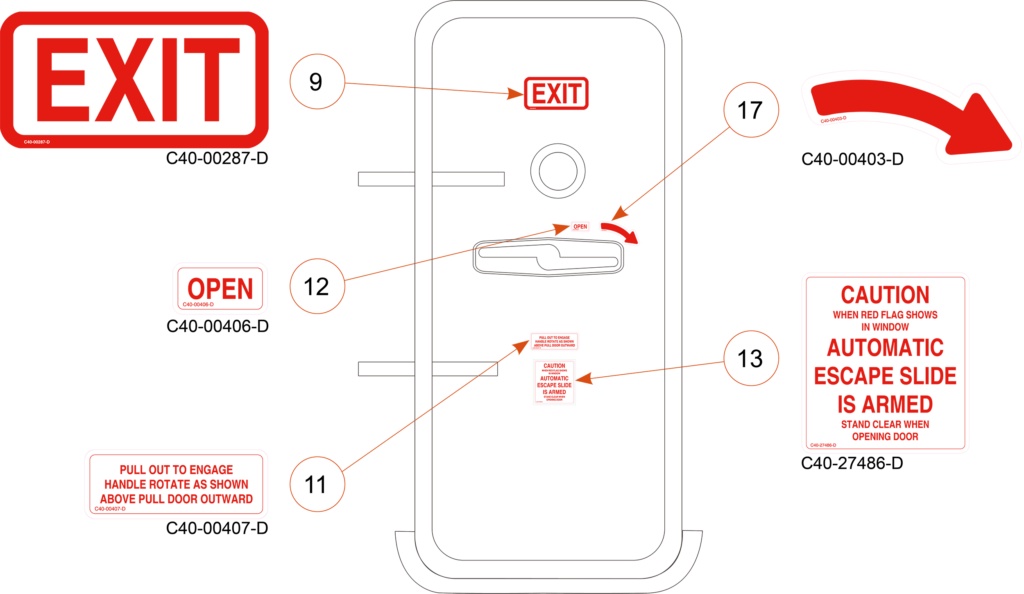
In the aviation industry, every detail counts. Technical markings in aviation play a vital role in the identification, operation, and safety of aircraft. Found both inside and outside the aircraft, they enable relevant information to be quickly communicated to crews, technicians, and maintenance personnel.
Whether they are aviation signage, identification labels, warning markings, safety instructions, or technical information, these elements must remain clear, legible, and suited to the specific conditions of the aviation environment.
Beyond their appearance, markings serve several essential functions on an aircraft. Here are five reasons why they are important in the aviation industry.
Aviation safety is one of the primary functions of technical markings. In an environment where flight crews, passengers, and ground crews must sometimes make decisions quickly, information must be immediately visible and understandable.
Safety markings are used, among other things, to identify emergency exits, hazardous areas, emergency equipment, controls, operational limits, and specific instructions. Their placement, legibility, and durability are therefore essential.
In many aviation applications, placards and markings must be prominently displayed and provide the information necessary for the safe operation of the aircraft. Canadian standards include requirements regarding certain markings, placards, and information necessary for the safe operation of aircraft.
Well-designed markings are therefore not merely a graphic element. They play a direct role in the effective communication of information related to aircraft safety.
Technical markings also helpidentify aircraft, their components, and various pieces of equipment.
Identification numbers, plates, technical labels, and registration marks enable operators, technicians, and authorities to quickly identify the information associated with a specific aircraft or piece of equipment.
In Canada, Transport Canada specifies that aircraft markings are a form of identification that allows a specific aircraft to be quickly identified. Canadian civil aircraft must display their markings when in operation, both on the ground and in flight.
This clear identification is particularly important in an industry where traceability and accuracy are key.
Properly designed and applied aircraft markings thus facilitate visual identification while helping to maintain a consistent and professional appearance for the aircraft.
Aviation technical markings are also useful to teams responsible for aircraft maintenance.
During inspections, maintenance, or repairs, technicians must be able to quickly identify certain areas, controls, access points, equipment, and safety precautions. Clear instructions can make their work easier and reduce the risk of confusion.
Markings can be used, among other things, to identify access points, maintenance areas, warnings, operating instructions, or other information related to operation and maintenance.
In aviation technical standards, signs, labels, and markings can convey important information related to safety and maintenance.
For this reason, the quality of a marking is not limited to its appearance at the time of installation. Its durability, adhesion, resistance, and legibility over time are also important to ensure that the information remains accessible throughout its useful life.
The aviation industry operates in a highly regulated environment. Depending on the aircraft, its use, and the type of marking involved, different requirements may apply to identification, placards, registration marks, and safety information.
Aviation compliance is therefore an important consideration in the design and manufacture of technical markings.
In Canada, for example, Transport Canada standards establish specifications regarding the display and application of aircraft markings. In particular, they specify certain requirements regarding their permanence, contrast, location, and presentation.
The design of an aviation cabinet or technical marking must therefore take into account its actual use, its location, and the requirements applicable to the project.
Working with a supplier that has experience in the aerospace industry makes it easier to incorporate these considerations from the design and manufacturing stages onward.
An aircraft operates under specific conditions. Its surfaces and equipment may be exposed to temperature fluctuations, cleaning procedures, wear and tear, handling, and various operational environments.
Durable aviation markings must therefore be designed using materials and processes suited to their intended use.
Markings that become difficult to read, deteriorate prematurely, or peel off may lose their primary function. That is why the selection of materials, adhesives, printing processes, and installation methods plays an important role in the quality of the final result.
Readability is just as important. Information must be easy to understand at a glance, especially when it comes to safety signs, emergency instructions, or markings intended for maintenance crews.
The combination of readability, durability, and manufacturing tailored to the application thus helps ensure the marking’s performance throughout its service life.
Technical markings are much more than just visual elements. They contribute to aviation safety, identification, maintenance, compliance, and the communication of essential information on board and around an aircraft.
Libellule Monde supports its customers in the design and manufacture of aviation marking solutions tailored to the needs of aircraft. Thanks to its expertise in the aviation sector and its Transport Canada approvals, the company develops solutions designed to meet its customers’ technical needs.
Well-designed aviation technical markings thus convey information clearly and durably, while helping to maintain high standards in the aviation industry.